Sadie was observant, interested, and as always, curious, during my first reading of Anti-Racist Baby by Ibram X. Kendi. This is a book that hopefully, with each read and as Sadie matures will spark more questions and observations. We looked together at the beautiful picture of a bunch of neighbors of different ages, races and ethnicities. I pointed out the different skin colors, hair color and textures as well as how unique everyone’s eyes were. We reinforced 1 Open your eyes to all skin colors. On another page there are five babies of different races and ethnicities, most likely around 8-10 months old, sitting and interacting on a blanket. Before COVID Sadie and I would go to the library once or twice a week. This is exactly what it was like! A lot of different people, caregivers of all races and ages (Hats off to the Grandmas!) together with a mix of wonderful babies and toddlers all there with a shared purpose, to expose our little ones to early literacy skills and age appropriate social experiences. “Remember when we used to go to the library Sadie? It was just like this.” “Yes, Grandma”, Sadie agreed. The library is a wonderful way to reinforce step number 5 Celebrate all our differences. About to finish the book, we landed on 8 Grow to be an antiracist where a group of young adult friends were all sitting on a couch together. Before I read the page Sadie blurts out, “Look, they all have different eyes.” Now that was a successful first reading of Antiracist Baby to my 2 1⁄2-year-old Granddaughter!
Showing posts with label Equity. Show all posts
Sunday, September 6, 2020
Tuesday, December 3, 2013
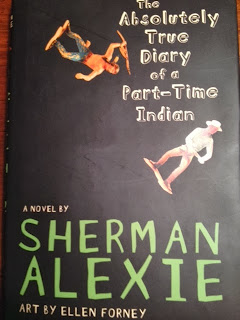
Banned Books:Absolutely True Diary of a Part-Time Indian
At my home a “banned book” is a book collecting dust on a
shelf, usually bought for one of my (adult) sons whom unfortunately, have yet to
acquire a love of reading. The book sits there, silent, and then all of a
sudden it screams out – read me, read me please. Well, mom picks it up to read.
There is always a catalyst. So on Thanksgiving Day I read The Absolutely True Diary of a Part Time Indian by Sherman Alexie….
Librarians and media specialists were the catalysts this time. I recall a
conversation I had this summer with my cousin whose husband is a middle school
media specialist; she said “You have got to read this book!” then just last
week I was browsing through the library site of my Alma Mater and ran across a
blog post about banned books week, which included a segment on Alexie’s book. I
went down to my son’s room, pulled that book out, dusted it off and it became
my Thanksgiving read. No regrets. Powerful! I am not going to comment on the varied
reasons parents want this book off the shelf…my only hope is that by banning
it, it will get more attention, and the masses will read it and thus be exposed
to the difficult issues that surround all of us: educational inequality, social
injustices, and cultural misunderstandings. For it is only through exposure and
education that we can achieve a more harmonious being. Isn’t it ironic that
adults work to shelter their children from the essential societal dialogs that
could lead to more integral understandings (education) of our shortcomings?
My take-aways can be categorized under the following
themes: self-identity, crossing borders,
social justice, hope/courage, and supportive relationships.
Self-identity
Junior identifies as an intelligent, proud, quirky American
Indian from the Spokane Indian reservation in Washington, who comes to the
realization that the context of his reservation community is incompatible with the
hopes and dreams he has for himself. He realizes that in order to receive a
decent education he must leave the Rez (reservation) and enter the white-mans world,
which then leads to constant emotional, social, and physical challenges. Recognizing
and accepting his identity is exceptionally painful for Junior who analyzes,
through his adolescent brain, the circumstances that have led to poverty, alcoholism
and lack of self-worth among members of the Reservation. Although only an
adolescent, I believe Junior is conflicted by his inability to change the
circumstances of his people, and struggles with his conclusion that his only
hope is to leave those circumstances. Thus he accepts his identity as an Indian
betraying his community by entering a white world.
Crossing borders
Junior, a recognized Indian name, remains a resident of his
reservation, but commutes daily, as Arnold, his given name, to the suburban
white high-school of Reardan. His need to navigate multiple border-crossings is
overwhelming. Poor to rich(er) and Native American to white dominate his being.
Culture shock and mental and physical fatigue accompany his daily “crossing”
from home to school and school to home. He navigates distinct cultural
experiences that include making friends and socializing, gaining knowledge and
accessing academic resources; expressing pride and negotiating acceptance.
As an educator in a middle to upper-class, majority white,
suburban school, I wonder how many of our students must “cross borders” on a
daily basis. What can we as educators do to ease, understand and facilitate
this border crossing? Arnold was accepted into his new community, and I believe
the educational community that I am part of is also welcoming and accepting;
however, I feel that it is our obligation to strive to facilitate less
traumatic “border crossings” and I wonder what we can do as a community to
achieve that?
Illustration pg. 43 by Ellen Forney
Hope and Courage
This coming of age novel is truly one of hope and courage. Junior’s
hope for a better life led him to seek out a higher quality education; and it
took great courage to put aside the forces of a group-oriented culture to enter
one that focuses on the individual.
Indeed, leaving a community where the expectation is to put ones group
above oneself, led to rejection and hostility which made his journey all the
more difficult. Courage led him to walk many miles each day; led him to accept
the loss of his life-long friend; led him to ask a white girl to the homecoming
dance; and to share in the joy of learning whether that be on the basketball
court or in the classroom. Learning
about his world through his story gave me hope as well; as it was clear that
the students of Reardan learned through his realities, were empathetic and began
to understand more about a the culture of one’s neighbor which at one time
seemed to be a distant land.
Social Justice
A glimpse into the world of this Indian reservation
highlights a variety of social justice issues that although are perpetuated
within certain Indian lands, also exist in many areas of our society. Extreme
poverty due to systematic societal inequities; educational inequality or simply
no access to any decent education; cultural isolation and a sense of
inferiority leading to a mirage of mental illness and addiction. Wondering how to best address these issues?
Supportive Relationships
In the end it was very humbling to view the development of
relationships between Junior and others. To experience the type of support,
against all odds, that he received from his mother, father, sister and
grandmother was sobering. The importance he gave to developing friendships
within the Rez, at his new school, with his girl friend and among his teammates
was courageous and genuine. The attention he gave to the advice his Rez teacher
gave him, made a world of difference to his future. It certainly sends the
message that no matter what our background and culture is we thrive on relationships
and need support from loved ones both during challenging times as well as times
of celebration.
A wonderful Thanksgiving read, ironically leading me to
ponder – with this particular population should we be offering thanks or asking
for forgiveness?
Friday, July 27, 2012
Economic Inequality...Educational Opportunity: the chicken or the egg?
Post Four of series “It is not enough to be
compassionate you must act (14th Dalai Lama).”
Economic inequality
Below I have summarized the findings outlined in Barbara
Ehrenreich’s book, Nickle and Dimed: On (Not) Getting by in America:
·
No, you cannot survive and take care of your
basic needs on a minimum wage salary.
·
The welfare system has unrealistic expectations
of those who need assistance. (For example, the system assumes those in need
can mobilize easily to apply for multiple positions in an extended radius).
·
Within the United States there exists a “culture
of inequality,” where low- wage workers face daily hurdles and repressive
measures that stagnate their possibilities of a stable lifestyle.
Dr. Ehrenreich set out to test her ability to survive and
meet her immediate needs on a minimum wage salary for a period of nine months. She
moved from Florida to Maine and finally to Missouri working in a variety of
settings to cover her basic needs. This first hand account enables one to
identify and understand the daily plight of the low-wage worker. After reading Nickle and Dimed I conducted a web
search to determine why so many colleges and some high schools had chosen this
book as a summer read. I found no substantive information beyond lists of
reflection questions. However, this book did find its way to the reading list
of my doctoral course on Economics and Leadership, although, as a group we chose
to read Savage Inequalities by Kozol,
an account of the incredibly poor state of public education in certain
“unattended to” areas throughout the country. I knew I would get to this book
someday and I am very happy that I did.
To stimulate change, who should be reading this book? How many policy
makers and politicians have read Nickle
and Dimed and would that make a difference?
Inequality of opportunity
The very same day I finished Nickle and Dimed I picked up the Washington Post and read Larry
Summer’s op ed article (7/16/12), Our
inequality of opportunity…. Summers first states that the distribution of
income is far worse than it was a generation ago, and with the present state of
the economy, this trend will continue. (No progressive made since the
publishing of Nickle and Dimed!) He briefly outlines the progressive and
conservative viewpoints suggested to alter these economic trends, but quickly
moves to encourage a different dialog on economic policy, that of improving
equality of (educational) opportunity. If we want workers to have better
opportunities, shouldn’t we ensure that they can afford and receive a high
quality education? Summers suggests that:
·
We improve public education (wow! – a huge feat)
·
Universities continue to work to increase
enrollment of minority populations.
·
With the same push universities have put toward increasing
racial and cultural diversity, they should set in place policies to increase
economic diversity.
I have not achieved much through this blog beyond
summarizing a study and an opinion on the state of our economy with a suggested
correlation to the state of our education system. Is this a, what came first, the chicken or
the egg scenario? Does the lack of educational opportunity create poverty or do
the dire economic conditions make educational opportunities inaccessible for
many? I wish I could do more; I admit that I feel a bit hopeless. Well, I did
find a new twitter follower
(WeCanEndPoverty) to give me some ideas, and I have investigated when the next
Literacy Volunteers of America training is taking place in my area. What else
can I DO to make a difference? Maybe the courageous approach taken by the author
of the next book I am reading, The Fist
and the Heart, will motivate me to DO more to help change this “culture of
inequality.”
Tuesday, June 19, 2012
Privilege and Identity in Elite High Schools
-->
-->
-->
Post One of series “It is
not enough to be compassionate, you must act.”14th Dalai Lama
Was it an ironic coincidence that I read Adam Howard’s Elite Visions: Privileged Perceptions of Self and Others (Teachers College Record Volume 112, Number 8, 2010, p. 1971-1992 http:// www.tcrecord.org ID Number: 15799, Date Accessed: 5/15/2012) and then set off to the public library to review my son’s high school required summer reading list, which this year consists of books that fall under a school wide theme - compassion?
Those familiar with the scholarly literature on
privilege know that one must view privilege through the lens of one’s
advantages (visible and invisible) instead of through the disadvantages of
others. If we are to break the chain of
inequality we must view the varied components of privilege as power links
within that chain. Howard, in the
above-cited article, introduces identity as an added link closely connected to
one’s privilege. His research looked at elite
high school students’ perceptions of privilege; he found that his participants
connect their privilege to their sense of self. Specifically, privilege was not simply about
the advantages one has or doesn’t have, but who they are as people, and their
earned place in the world as privileged citizens. “ ‘It is just the way the
world works.’ They accepted unfairness [inequality] as natural and unavoidable
(p. 9)”
Students consciously or unconsciously work to justify
and internalize their sense of privilege.
This is constructed from their knowledge base, their ways of knowing the
world. As an educator it is my responsibility to help students understand other
ways of knowing, and thus enable them to adjust their worldview to make a
difference and break this chain of inequality.
In order to accomplish this Howard conveys the importance of exposing
students to alternatives to “privileged ways of knowing and doing (p. 10).” But he insists that in understanding students’
resistance towards alternatives, and acknowledging the commitment and desire of
educators to positively influence youth, we must work through this resistance and
take steps “toward transforming our students’ taken-for-granted assumptions
about themselves, Others, and the world around them (p. 10).”
So, when I visited the Summer Learning web page, The Glass Castle, Nickel and Dimed, and The
Soloist, quickly stood out and pushed me to reflect upon how as an educator
of an elite school, I can use these works that focus on poverty and inequality
not solely to think about compassion, but to help students think critically
about privilege and inequality. What is our role as educators and how can we
use the messages of these authors and characters to help our students break the
many links of the chain of power and privilege? How do we ensure that our
dialog on compassion moves beyond ideas and “feel good” tendencies and toward an
urge to influence social change?
I will try to follow the Dalai Lama’s advice, “It is
not enough to be compassionate, you must act.” Let’s act together and use this
theme of compassion as a launching point to help students move beyond simply
acknowledging the “taken for granted assumptions about themselves, Others, and
the world around them (p. 10).”
Friday, June 15, 2012
No more pulling my hair out....
Bold, compassionate, caring, just. There are many relieved, smart,
educated, young people out there who will have the opportunity to contribute to
our diverse American society. There are many happy families who will
remain as a family unit. Thank you Mr. President.
Who will benefit?
We all will. The young adults who will benefit from this policy change
are the youngsters who have spent time in our classrooms, who communicate,
collaborate and connect with all American students within our educational system
enriching our classroom communities. They were raised American, feel American
and should be given the opportunity to become legal citizens.
Why now?
It is graduation season. It is at this time of year that all of these
stories rise to the surface. Although a
temporary solution; it is bold and compassionate.
Subscribe to:
Posts (Atom)
